
Most of us have heard it all our adult lives: Buying in bulk saves money.
What if I told you that isn’t always true? Let me show you a couple examples of when buying less is saving more.
As I begin to restock, and build up my pantry for the season I have tried to be more focused on needs, not wants. One of the things I need is not to spend more than necessary for the basics.
My recent trip to the big box store caused me a double-take at prices on two very different products.
The box store, you’ll know which when you see the images, recently underwent a remodel to give it “super store” status. Along with the remodel came electronic price labels on the shelves. Electronic shelf labels, or ESLs, are digital price tags that allow retailers to automatically update product prices.
After seeing stories that some stores were caught changing prices in the middle of the day, (called dynamic pricing) while shoppers had the items in the basket already, I am a little leery of them. So, I try to really read the label when I shop.
This weekend I was stocking up on some miscellaneous items, along with some flour, rice, and sugar. I needed to stock up on dandruff shampoo. In the shampoo aisle I initially reached for the large bottle. I took the photo to use in a post on calculating savings when buying larger/bulk sized items. Then something caught my eye.
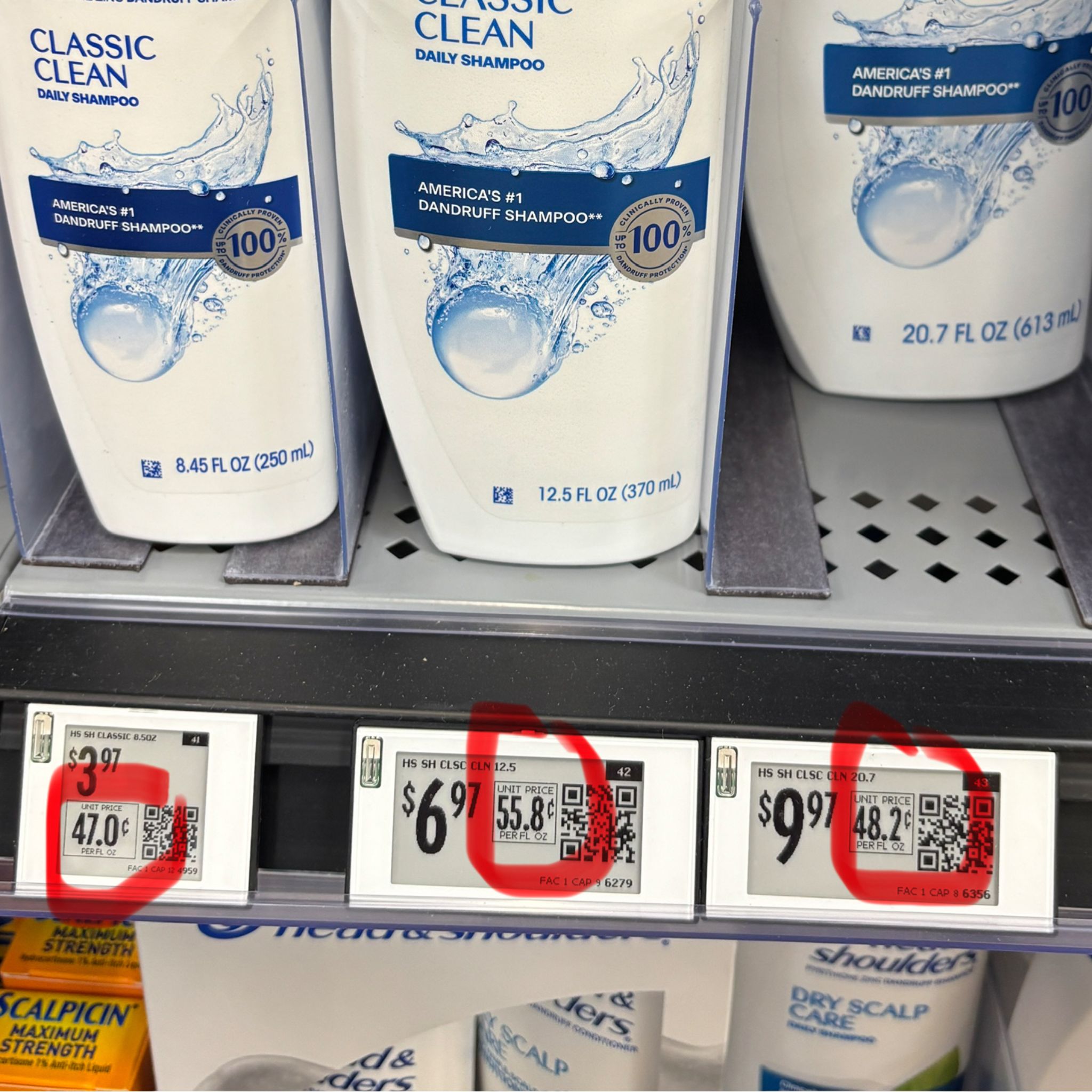
Zoom in on the cost per ounce. An 8.45 ounce bottle is $0.47 per ounce, the 12.5 ounce is $0.558, the 20.7 ounce is $0.482. If you purchase three 8.45 ounce bottles for $11.91, you will have 25.35 ounces. This weird pricing may be due to the smaller bottle being priced before tariff absorption ends.
I noticed the same thing when buying olive oil.

While a transition in tariffs or older inventory stock can certainly play a role in weird pricing differences, it isn’t the only reason bulk pricing breaks down. Retailers frequently use smaller items as loss leaders—heavily discounting a standard size to draw shoppers through the door, hoping they’ll fill their carts with other items while they’re there. Additionally, manufacturers often run targeted promotions or offer high-value coupons on standard, introductory sizes to encourage customers to try a brand. When those temporary discounts hit the shelves, the cost-per-ounce on a smaller bottle can easily beat out the standard “economy” bulk option.
If, like me, you can’t fork out $33 for not-a-gallon of olive oil (it’s actually 3 quarts, 5 ounces), you pick up a couple smaller bottles. In this instance the very small, 17 ounce bottle is a better buy.
Now, I totally understand that sometimes these price differences are marginal, just a few cents per ounce. In a time where every cent counts (Now that the U.S. Mint has stopped making pennies, every cent counts even more!) it is worth the label review.
#SmartShopping #PantryStockUp #ThriftyLiving #GroceryHacks #BudgetTips #EverydaySavings